
If your child is doing K1 Chinese, Malay or Tamil in 2027, there is something new: every K1 and K2 preschooler in Singapore is to receive their own copy of a Mother Tongue periodical, Thumbs Up Little Junior (Chinese), Cilik Cerdik (Malay) or Balar Murasu (Tamil). The Lee Kuan Yew Fund for Bilingualism announced this, and two new parent apps, on 27 October 2026.
Today the periodicals are shared, reaching about 43,000 children through MOE Kindergartens, Anchor Operator preschools and social service agencies. MOE has not published the start month or how often issues arrive, so this guide sets out what is confirmed, how Mother Tongue is decided at Primary 1, and a weekly routine to start now. More is in our learning topic.
At a glance
- 27 October 2026: at its 15th anniversary the Fund announced two initiatives from 2027 with SPH Media, in MOE's press release.
- Periodicals, 2027: all K1 and K2 preschoolers, about 72,000 children, are each to receive their own copy (same release).
- Apps, 2027: two new parent apps will accompany Cilik Cerdik and Balar Murasu, joining the existing Thumbs Up Little Junior app, with a Parent Centre and screen-time limits (same release).
- 3 March 2026: MOE's Committee of Supply release gave the three Mother Tongue Language Learning and Promotion Committees S$33 million for FY2026 to FY2030 and said they will support young parents in early Mother Tongue immersion.
- Primary 1 and 2: under MTL SOAR, from 2025, 30 minutes of Mother Tongue time goes to reading and library activities, reaching all levels by 2029, says MOE's September 2024 release.
What exactly changes for K1 and K2 children in 2027?
Two things, both introduced by the Fund in partnership with SPH Media.
- One copy per child. The periodicals, published by Lianhe Zaobao, Berita Harian and Tamil Murasu since 2013, 2014 and 2017, carry age-appropriate content rooted in local context, culture and values. Copies are shared now; from 2027 each K1 and K2 child is to have their own.
- Two new apps. Apps for Cilik Cerdik and Balar Murasu, in English and Malay or Tamil, will join the existing Thumbs Up Little Junior app, says the Minister's 27 October speech. Like it, they will offer stories, songs and games; they will also have a Parent Centre with access to the print publications, and parents can set screen-time limits.
Neither the release nor the speech says when in 2027 distribution starts, how often issues arrive, which title a child taking a different Mother Tongue receives, or what a child of K1 age who is not in preschool gets. Ask your preschool early in 2027.
What does K1 Chinese, Malay or Tamil look like at preschool?
Programmes differ between operators; MOE Kindergartens are the clearest public example. Their Starlight Literacy Programme page (updated 14 January 2026) says early childhood language learning focuses on listening and speaking, using Big Books, songs, rhymes and games set in the local context. They offer all three official Mother Tongue Languages.
- No worksheets. The curriculum page says that in place of workbooks or worksheets as homework, MOE Kindergartens encourage family-based learning activities.
- A weekly book. Under MK Reads!, children bring home an English or Mother Tongue book each week to read with a parent, says the resources for parents page (updated 23 June 2026).
- More time, in a pilot. In 2024 MOE announced a pilot at MK@Hougang and MK@Elias Park raising daily Mother Tongue time from 1 hour to 1.5 hours from the 2025 K1 cohort, to be scaled up gradually; we found no later update.
- A different MTL at preschool is not a P1 approval. Choosing a Mother Tongue unrelated to your child's ethnicity at an MOE Kindergarten does not carry over: you apply to the primary school at P1, case by case, subject to MOE's approval.
For fees, hours and registration, see our MOE Kindergarten guide.
How is the Mother Tongue decided at Primary 1?
Mother Tongue is compulsory, says MOE's primary school MTL page (updated 21 January 2026).
- Students of Chinese, Malay and Indian ethnicity study their own Mother Tongue.
- A child with a double-barrelled race is assigned the first component's language and may apply through the school for the second's.
- Eurasian students and those of other races whose mother tongue is not an official MTL can request any official MTL, subject to approval.
- Non-Tamil-speaking students of Indian ethnicity can apply to take Bengali, Gujarati, Hindi, Punjabi or Urdu; MOE does not provide these classes, which usually run outside school premises and hours.
In a March 2026 parliamentary reply, MOE pointed to the Mother Tongue Support Programme at Primary 3 and 4 and a less demanding curriculum from Primary 5, with exemptions for special educational needs only in exceptional circumstances. To see which year your child enters K1 and P1, use our K1 and P1 year finder.
A weekly Mother Tongue routine for a busy home
This is our suggestion, built on what MOE's preschool pages emphasise: listening, speaking, songs, rhymes and reading together, about 20 minutes on most days.
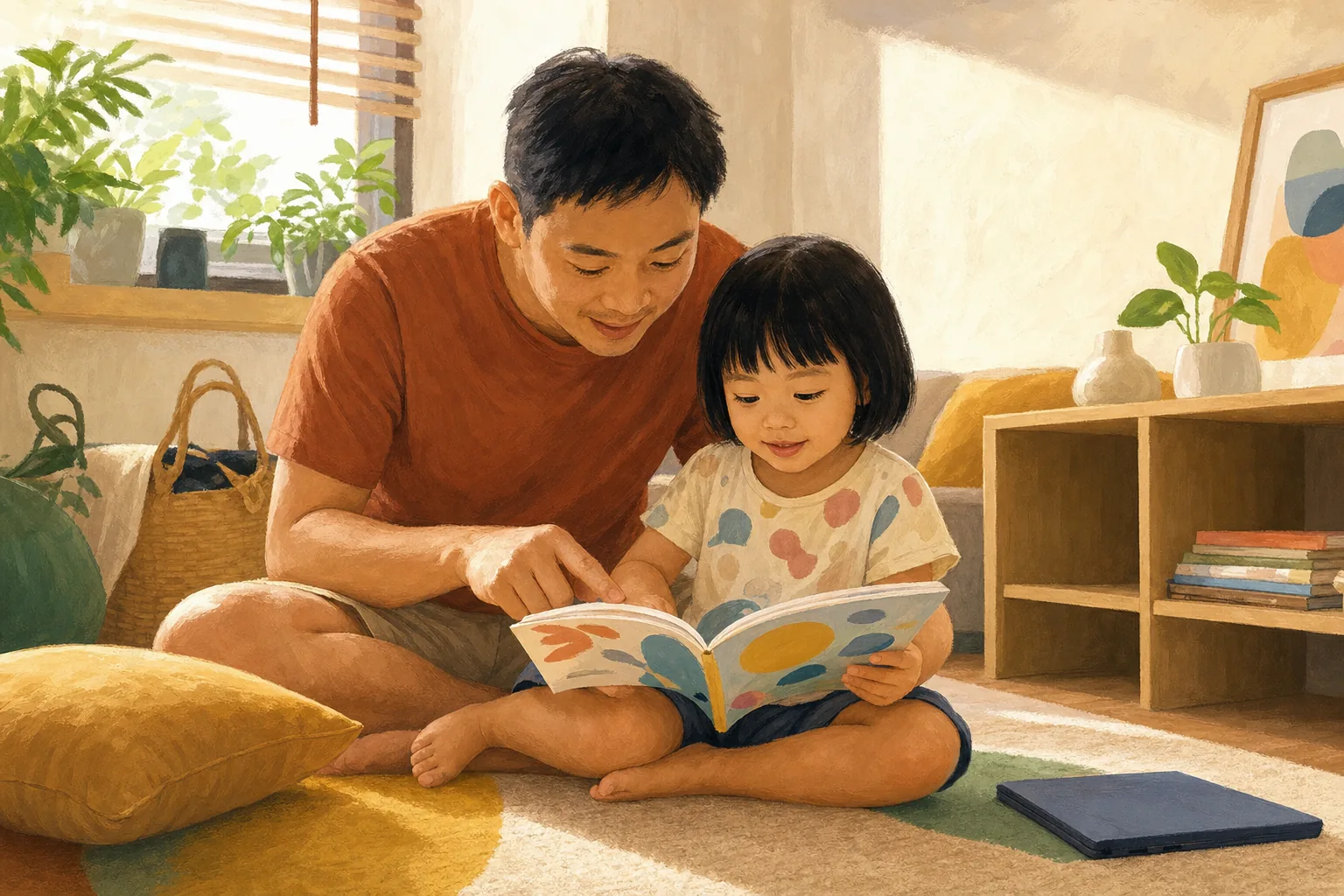
- Monday: the periodical, if it comes home, or the weekly book. Read it aloud together; if your own Mother Tongue is rusty, use the app's stories and songs or ask a fluent relative to read it once by phone, then reread it yourself.
- Tuesday: one song or rhyme. We suggest singing the same one all week, so it becomes familiar enough to join in.
- Wednesday: talk, do not quiz. Name five things at dinner or in the lift in the Mother Tongue, and let your child correct you.
- Thursday: a short app session. Set the screen-time limit before handing the phone over; our screen-time weekday plan has a way to fit it in.
- Weekend: the library. Borrow two Mother Tongue picture books alongside English ones; our library habit guide makes it routine.
Worked example (illustrative household, real NLB figures). Farah and Daniel's daughter, Aisyah, will be in K1 in 2027 and learns Malay; Daniel is fluent, Farah less so. On top of the periodical, they consider NLB's Little Book Box, which, according to its FAQ (updated 19 February 2026), sends eight books a month for children aged 18 months to nine, with an option of four English and four Mother Tongue books (Chinese, Malay or Tamil). A three-month cycle costs S$32.70 with home delivery or S$26.16 with locker collection, GST included.
- Per month: S$10.90 delivered or S$8.72 by locker.
- Per book: 24 books a cycle, 12 of them Malay, so about S$1.36 or S$1.09 a book.
- Late returns: loans last 21 days and cannot be renewed; overdue fines are S$0.15 per book per day, so a whole bundle three days late costs S$3.60.
Slots are limited and first come, first served, with no waiting list, and the subscription renews automatically. One change since we first checked: NLB's Little Book Box page now says the service will be discontinued on 1 April 2027, with new registrations accepted until 31 December 2026 and final deliveries by 31 March 2027. The same page says registration for the January to March 2027 cycle is open from 1 October to 30 December 2026, at the same fees. So for Aisyah it is one last three-month cycle at most; from April, the weekend library visit in the routine above has to carry the reading.
Do we need K1 Chinese tuition or enrichment?
Not by default, in our view. MOE Kindergartens give no worksheets as homework and focus on listening and speaking, so a paid class earns its place only if it solves a problem you can name, such as no one at home speaking the language. Try the periodical, the routine and the library for a term first. If you still want a class, our guides to choosing an enrichment class and choosing tuition help you check what it actually teaches.
Events help too: the Mother Tongue Languages Symposium, now in its 14th year, was held on 1 August 2026 at Singapore EXPO, and MOE's July 2026 release listed 42 sharing sessions and workshops for it, including strategies for parents to raise bilingual children.
Common questions
Will my K1 child get a Chinese, Malay or Tamil periodical in 2027?
Yes, every K1 and K2 preschooler is to receive their own copy of Thumbs Up Little Junior, Cilik Cerdik or Balar Murasu from 2027; the start month has not been published.
Which Mother Tongue will my child take in Primary 1?
Children of Chinese, Malay and Indian ethnicity take their own; other cases follow MOE's application rules, and a different language chosen at an MOE Kindergarten still needs approval at P1.
Are there apps for Malay and Tamil like Thumbs Up Little Junior?
Two are due in 2027, with stories, songs, games, a Parent Centre and parent-set screen-time limits.
Can I get Mother Tongue library books delivered?
Until March 2027: NLB's Little Book Box can send four English and four Mother Tongue books a month, at S$32.70 a three-month cycle delivered or S$26.16 by locker, but it takes new registrations only until the end of December 2026 and is discontinued on 1 April 2027.
Sources
- press release moe.gov.sg
- Committee of Supply release moe.gov.sg
- September 2024 release moe.gov.sg
- 27 October speech moe.gov.sg
- Starlight Literacy Programme page moe.gov.sg
- curriculum page moe.gov.sg
- resources for parents page moe.gov.sg
- primary school MTL page moe.gov.sg
- March 2026 parliamentary reply moe.gov.sg
- FAQ nlb.gov.sg
- Little Book Box page nlb.gov.sg
- July 2026 release moe.gov.sg
Something changed or worth adding?
Send a correction or suggestion

